
Names of the Church
All things of value have names. Although some would say that names are unimportant, we can easily see that this is not true. Can you imagine a husband thinking it unimportant that his wife would wear another's name? The Lord is just as vitally concerned with the titles of His church and His people.
The names by which the body of Christ is called are descriptive terms rather than proper names. We discover several such expressions applied to that body. The most common is "the church", an expression derived from a Greek word meaning "the called out". The church in the New Testament sense is composed of those who have been "called out" of the world of sin to become the people of God. The term is used in several ways - (1) in the universal sense to apply to all of the saved people throughout the world; (2) in the congregational sense to refer to a group of disciples working together in a congregation; (3) to an assembly of Christians called together for worship.
"Church" is often used without any additional identifying phrases. Sometimes, however, other expressions are added to more completely describe it. Thus we read, "Keep watch over yourselves and all the flock of which the Holy Spirit has made you overseers. Be shepherds of the church of God, which he brought with his own blood."(Acts 20:28) Since Christ purchased the church with His blood, "God" evidently refers here to God, the Son, or Jesus Christ. The word "God" is a term of deity and applies to the Son as well as to the Father. "Church of God" is used several times in the Scriptures.
In Romans 16:16 we read, "The churches of Christ send greetings" The plural is used since a number of congregations are referred to. That the church belongs to Christ we further know since He declared, "And on this rock I will build my church."(Matt. 16:18) Again, the church is His body. "Now you are the body of Christ, and each one of you is a part of it."(1 Cor. 12:27) In Ephesians 5:22, 23 Paul shows that the church is married to Christ as a wife is married to her husband. When possession is shown the church should wear His name as the wife wears the name of her husband. The glory and honor belong to the Son of God, not a religious teacher or reformer, regardless of how great he may be.
Other phrases designating the church include (1) the church of the firstborn (Heb. 12:23); (2) the kingdom (Heb. 12:28); (3) the way (Acts 19:9, 23); (4) the family of believers (Gal. 6:10).
Terms Applied To Disciples
Two expressions identifying the early followers of Christ are found in Acts 11:26. "The disciples were called Christians first at Antioch." A "disciple" is a follower. All who follow Jesus are His disciples. The term Christian became the name worn by these people. As the name indicates (Christian) a Christian is a disciple of Christ. Thus Peter declares, "However, if you suffer as a Christian, do not be ashamed."(1 Peter 4:16) Never do we read of Peterite Christians or Paulite Christians. Neither today is the Lord pleased with denominational prefixes which are added to His name.
Disciples are also called saints. "To all in Rome who are loved by God called to be saints."(Rom. 1:7) "Saint" means "holy one" and since all Christians are to be holy, all are therefore saints. Canonization by a religious organization is not necessary. Other expressions applied to God's chosen are brother (Col. 1:2), priesthood (1 Peter 2:5, 9), and heirs (Rom. 8:17).Unity of the Body
The undivided nature of the church is expressed by Paul in Ephesians 4:3-6. "Make every effort to keep the unity of the Spirit through the bond of peace. There is one body and one Spirit - just as you were called to one hope when you were called - one Lord, one faith, one baptism; one God and Father of all, who is over all and through all and in all." The many bodies, many faiths, and many baptisms of our day were unknown in the first century. The prayer of Jesus recorded in John 17 was that His disciples might be as united as were He and the Father. The blessing of unity had been recognized many years before by David when he declared, "How good and pleasant it is when brothers live together in unity!"(Psalm 133:1)
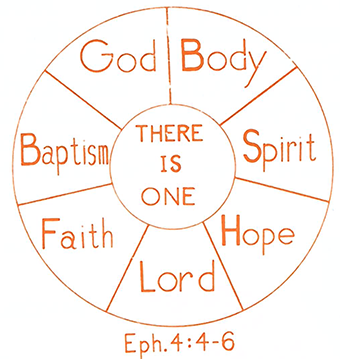
Yet even in apostolic times efforts were made to divide the church. Paul wrote the Corinthians, "I appeal to you, brothers, in the name of our Lord Jesus Christ, that all of you agree with one another so that there may be no divisions among you and that you may be perfectly united in mind and thought. My brothers, some from Chloe's household have informed me that there are quarrels among you. What I mean is this: One of you says, "I follow Paul"; another, "I follow Apollos"; another, "I follow Cephas"; still another, "I follow Christ." Is Christ divided? Was Paul crucified for you? Were you baptized into the name of Paul?"(1 Cor. 1:10-13) This unfortunate division came because some were following and wearing the names of men rather than Christ. If we were to follow any man, who could be greater than Paul? Yet Paul denounces the wearing of his name. Much religious division could be removed if all human denominational names were discarded in favor of those expressions found in God's word.
Likewise unknown in the primitive church were the denominational organizations and creeds which serve to perpetuate division today. The early Christians maintained unity because they were content to accept only those teachings which have been revealed to us in the New Testament. May we too strive for religious unity by letting Christ be our only creed and the Bible our only guidebook.