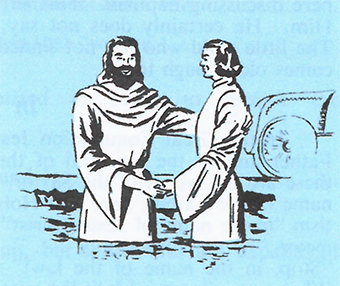
Jesus said, "What good will it be for a man if he gains the whole world, yet forfeits his soul?"(Matt. 16:26) Any subject that relates to the salvation of our most important possession - the soul - needs our careful study. Since Jesus also said, "Whoever believes and is baptized will be saved,” baptism in water is such a subject.
In this lesson our aim is to determine the place that baptism filled in New Testament times rather than to examine its modern usage. We will try to answer these questions: (1) What method (immersion, sprinkling, or pouring) was employed? (2) What was the purpose of baptism? (3) Who were baptized? (4) In whose name were they baptized? First, however, note that water baptism should not be confused with Holy Spirit baptism to be examined in another lesson. Except for the six times that Holy Spirit baptism is mentioned, almost every scripture using the words "baptize" and "baptism" applies to baptism in water.
The Method
A vital question is whether immersion, sprinkling, pouring, or all three are authorized in the Scriptures. Almost all Greek scholars agree that the word baptize as used in the New Testament means to dip, submerge, or immerse. Whether they are correct can be determined by uses of the word in the New Testament.
The first person to baptize in New Testament times was John the Baptizer. Of him it is said, "Now John also was baptizing at Aenon near Salim, because there was plenty of water."(John 3:23) We are certain that John immersed since neither pouring nor sprinkling requires much water. However, immersion does. When Jesus was baptized by John it is said, "As soon as Jesus was baptized, he went up out of the water."(Matt. 3:16) "As Jesus was coming up out of the water, he saw heaven being torn open."(Mark 1:10) Had Jesus not gone into the water He could not have come up out of it. Furthermore, He would have been foolish to have walked into the River Jordan up to His waist only to have John sprinkle some water on Him when such could have been done on the shore. Every indication is that Jesus was immersed.
We are told of the conversion of the Ethiopian, "Then both Philip and the eunuch went down into the water and Philip baptized him. When they came up out of the water, the Spirit of the Lord suddenly took Philip away."(Acts 8:38, 39) This clearly shows that the eunuch was immersed.
Paul calls water baptism a burial. "We are therefore buried with him through baptism into death. (Rom. 6:4) "Buried with him in baptism..."(Col. 2:12) Only immersion can truly be called a burial. But were sprinkling and pouring ever used in apostolic days? A careful study of the New Testament reveals not a single passage mentioning either sprinkling or pouring of water. We must conclude that neither was employed or authorized by the apostles.
The Purpose
Those baptized in apostolic times were immersed for the remission or forgiveness of sin. "Repent, and be baptized, every one of you, in the name of Jesus Christ for the forgiveness of sins. And you will receive the gift of the Holy Spirit."(Acts 2:38) "Get up, be baptized and wash your sins away."(Acts 22:16) Since we cannot be saved without forgiveness it follows that baptism is necessary for salvation. Thus we read, "Whoever believes and is baptized will be saved."(Mark 16:16) "This water symbolizes baptism that now saves you also."(I Peter 3:21)
But why does baptism save? It saves because it puts us into Christ where we may obtain forgiveness through His blood. Paul speaks of "the redemption that came by Christ Jesus."(Rom. 3:24) He also teaches, for all of you who were baptized into Christ have clothed yourselves."(Gal. 3:27) "Or don't you know that all of us who were baptized into Christ Jesus were baptized into his death?"(Rom. 6:3) Therefore we cannot be saved unless we are in Christ where we reach His redeeming blood, and we cannot get into Christ without being baptized.
We must also conclude that forgiveness never proceeds baptism, but is a direct result of it. Never is baptism called "an outward sign of an inward grace." It never expresses the idea that one is already a child of God, but it is the act by which one becomes a Christian.
The Subjects
It is sometimes asked whether the Bible teaches infant or adult baptism. Actually, neither is taught. What is taught is believers' baptism. Jesus says, "Whoever believes and is baptized will be saved."(Mark 16:16) In Acts 18:8 we read, "And many of the Corinthians who heard him believed and were baptized." We have no command to baptize those incapable of believing. Furthermore, those to be baptized must be teachable. In the Great Commission Jesus says, "Therefore go and make disciples of all nations, baptizing them in the name of the Father and of the Son and of the Holy Spirit."(Matt. 28:19) Again, repentance is a prerequisite of baptism. "Repent and be baptized ..."(Acts 2:38) the one who has not sinned has nothing of which to repent and is not told to be baptized.
An infant which cannot believe, be taught, nor repent is not a subject of baptism. Furthermore, it has no need to be baptized "for the remission of sins" because it has no sins to be remitted. There is not a command or example in the Scriptures that even hints at infant baptism. Advocates of infant baptism cite Matthew 19:14 as authority. This says, "Suffer little children, and forbid them not, to come unto me: for of such is the kingdom of heaven." But Jesus was not here discussing baptism. Furthermore, those mentioned were able to "come" to Him. He certainly does not say, "Bring little children to me to be baptized." The little child who has not sinned is as sure of heaven as any adult until he becomes old enough to sin.
In Whose Name
In the Great Commission Jesus says, "Baptizing them in the name of the Father and of the Son and of the Holy Spirit."(Matt. 28:19) Since these are the words of the Savior, we cannot go wrong when we baptize into the name of the Father, Son, and Holy Spirit. In Acts 2:38 Peter commanded baptism "in the name of Jesus Christ". The expression "in the name of ..." often means "by the authority of ..." A policeman who shouts to a fleeing criminal, "Stop, in the name of the law!" means, "Stop, by the authority of the law!" When one is baptized into the name of the Father and of the Son and of the Holy Spirit, he is baptized in the name of Jesus or by His authority since Jesus gave the command Himself.
When changes are made on such subjects as baptism it is extremely dangerous. If we wish to reach the heavenly home we will find it is much safer to comply with the Lord's command on baptism than to risk our eternal salvation by altering it in some way.
| Have you been scripturally baptized? If you have not and wish our assistance, we will be happy to help you. Check if you wish our help. ______ |