Ten days after His ascension into heaven, our Lord Jesus Christ brought His church into existence in Jerusalem. How it was established is told in the Acts of the Apostles, the only strictly historical book in the New Testament. Acts, written by the physician Luke, is a chronicle of some of the activities of some of the apostles as they spread the gospel and planted the church. It gives special emphasis to the work of Peter and Paul. In this lesson we will study the establishment of the church and related events as recorded in the first seven chapters of the book.
The body of Christ is described by a variety of terms in the Scriptures. Among these are the expressions "church" and "kingdom of God" or "kingdom of heaven". That the church and kingdom are different names applying to the same body is shown by Jesus when He says to Peter, "And I tell you that you are Peter, and on this rock I will build my church... I will give you the keys of the kingdom of heaven."(Matt. 16:18, 19) Since Jesus uses the two expressions interchangeably, we shall do so in this investigation of the planting of His church.
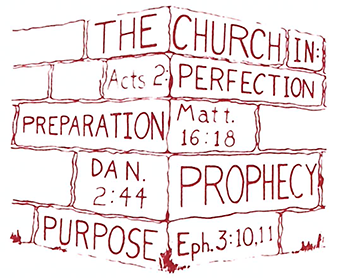
The Church in Purpose
Before the church became a reality it existed in the mind or purpose of God. Paul declares, "His intent was that now, through the church, the manifold wisdom of God should be made known to the rulers and authorities in the heavenly realms, according to his eternal purpose which he accomplished in Christ Jesus our Lord."(Eph. 3:10, 11)The Church in Prophecy
The Almighty by prophecy first revealed to man His purpose with the church. Daniel, interpreting King Nebuchadnezzar's dream, foretold, "In the time of those kings, the God of heaven will set up a kingdom that will never be destroyed, nor will it be left to another people. It will crush all those kingdoms and bring them to an end, but it will itself endure forever."(Dan. 2:44) As yet, though, the spiritual nature of the kingdom had not been made known.
The Church in Preparation
The preparation period of the church was first declared by John the Baptist; a few months before Christ began His personal ministry. John proclaimed the imminence of the kingdom saying, "Repent, for the kingdom of heaven is near."(Matt. 3:2) Soon Jesus Himself said, "Repent, for the kingdom of heaven is near."(Matt. 4:17) He sent His disciples forth with the admonition, "And you go, preach this message: The kingdom of heaven is near."(Matt. 10:7) Still later He promised, "And on this rock I will build my church."(Matt. 16:18)
Jesus told His disciples how, when, and where He would establish His church. "I tell you the truth, some who are standing here will not taste death before they see the kingdom of God come with power."(Mark 9:1) "But you will receive power when the Holy Spirit comes on you."(Acts 1:8) "But stay in the city until you have been clothed with power from on high."(Luke 24:49) Combining these passages we learn that (1) the church would be established during the apostles' lifetime, (2) it would come with power, (3) it would be set up in Jerusalem.
The Church in Perfection
The first chapter of Acts finds the apostles waiting in Jerusalem in compliance with the Lord's instructions. While so doing they chose Matthias as apostle to replace Judas Iscariot who had hanged himself. Just ten days after Jesus ascended and fifty days after the Passover at which He was crucified the day of Pentecost arrived. Thousands of Jews from every nation gathered for the feast. At about 9:00 a.m. the apostles were assembled when "Suddenly a sound like the blowing of a violent wind came from heaven and filled the whole house where they were sitting. They saw what seemed to be tongues of fire that separated and came to rest on each of them. All of them were filled with the Holy Spirit and began to speak in other tongues as the Spirit enabled them."(Acts 2:2-4)
Here was the power which Jesus had promised would accompany the establishment of His kingdom. The church had existed in purpose, prophecy and preparation and now was to be established in perfection. The apostles seized the opportunity to preach Christ to the assembled multitude. Then a most unusual thing happened. Every man heard the preaching in his own language. The people were amazed. Some suggested that the apostles were drunk. Finally, Peter stood before them and began to speak. He explained that they were not drunk, but that this miraculous display of power was from God and had been predicted by the prophet Joel. He told them that the One they had crucified was actually the Son of God, and that God had raised Him from the dead.
So powerful was this sermon that it cut to the heart of the people. They said, "Brothers, what shall we do?"(Acts 2:37) They realized that they had slain the Son of God and in some way must secure forgiveness. Peter replied, "Repent, and be baptized every one of you, in the name of Jesus Christ for the forgiveness of your sins. And you will receive the gift of the Holy Spirit. The promise is for you and your children and for all who are far off - for all whom the Lord our God will call."(Acts 2:38, 39) Thus he declared that their forgiveness (and ours as well) could not be secured until they had repented and been baptized. That day about 3000 people were baptized for the forgiveness of sins. The church was established. Thereafter it is spoken of as being an existing institution.
At the same time that the first converts were saved the Lord added them to His church. "And the Lord added to their number daily those who were being saved."(Acts 2:47) They were saved from their sins and became a part of the church in the same action. Thus the church in the undenominational sense was and is composed of the saved; one cannot be saved from his past sins without being in the church; one cannot be in the church without being saved. Furthermore, we learn from this scripture that the early Christians were added to the church by the Lord rather than "joining" it of their own volition as we so often hear the expression today.
The first Christians worshipped in a simple manner. "They devoted themselves to the apostles teaching and to the fellowships, to the breaking of bred and to prayer."(Acts 2:42) The breaking of bread was the Lord's Supper. The church grew rapidly. Peter and John healed a lame man and this excited the opposition of the Jewish leaders. They arrested Peter and John, threatened them, and let them go. When they resumed their preaching, they and the other apostles were again arrested. Cast into prison, they escaped by a miracle to return to preaching Christ. Once more they were arrested, threatened, beaten, and finally released.
The church had other problems. There was much poverty and to cope with it many Christians sold their possessions and brought the money for distribution to the needy. A man named Ananias and his wife, Sapphira, sold a piece of land, but tried to deceive the apostles by pretending they were giving it all when they were not. For their lie, God struck them dead and fear came on all the church. When some complained that the widows of the Grecian Jews were being neglected, the apostles appointed seven men to supervise the daily ministration. One of these men, Stephen, soon was involved in a dispute with some Jews. When he was arrested he preached a sermon before the Jewish council. So angered were those who heard him that they stoned Stephen, the first Christian to die as a martyr. As they took his life they laid their coats at the feet of a young man named Saul who later became a Christian and whom we know as the great Apostle Paul.