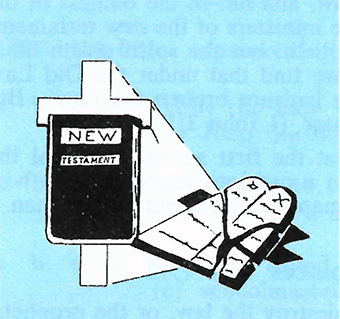
On the page proceeding the New Testament books in the American Standard Version of the Bible you will read, "The NEW COVENANT COMMONLY CALLED THE NEW TESTAMENT OF OUR LORD AND SAVIOUR JESUS CHRIST." It is correct to call the New Testament the New Covenant because the word in the Greek from which "testament" is translated also means "covenant.
When Christ died on the cross He left a testament (or will). This testament was also a covenant between God and man. (A covenant is an agreement or contract between two or more parties) The Bible recognizes two such covenants that God has made with man. "For if there had been nothing wrong with that first covenant, no place would have been sought for another."(Heb. 8:7) In both of these contracts God promised certain blessings to man, conditioned on man's obedience to God's laws.
The First or Old Covenant
The old covenant was first made with Abraham, and later repeated (except for that portion fulfilled in Christ) in the Law of Moses. In a previous lesson we learned that God promised Abraham (1) to make of him a great nation, (2) to make his name great, (3) to give him a land, (4) to bless those who blessed him and curse those who cursed him, and (5) to bless all of the nations of the earth in his seed. (Gen. 12:1-7) As a sign of this agreement God required Abraham and his descendants to be circumcised.
This covenant was not in written form until repeated in the Law of Moses. The Law restated the promises and added regulations to be obeyed by the children of Israel. It included (1) the ten commandments, written on tables of stone(Ex. 34:27, 28) and (2) the other portions of the Law called the book of the covenant.(Ex. 24:7) The Law of Moses was given only to the Jews, and lasted only until the death of Christ. It was a law of the letter rather than of the spirit, and was sealed by the blood of animals which the Jews offered regularly to God. (Heb. 9:18-21)
The Old Covenant accomplished several things. (1) It fulfilled the promises made by God to Abraham except that which pertained to Christ. (2) It revealed the true nature of sin. (Rom. 5:20) (3) It served as a reminder of sin.(Heb. 10:3) (4) It was a temporary expedient until Christ would replace it with a better covenant by His death on the cross.(Gal. 3:19-25)
The Second or New Covenant
The New Covenant is far more important to us than the Old. The prophecy of Jeremiah that God would make a new covenant with His people (Jer. 31:31-34) was fulfilled when Christ ushered in the New Covenant by shedding His blood on the cross. This was the fulfillment of God's promise to Abraham to bless all the nations of the earth in his seed. (Gen. 22:18) Jesus, a descendant of Abraham, blessed all mankind by making salvation from sin possible through His shed blood. The terms of the New Covenant are revealed in the twenty-seven New Testament books.
A major difference between the two covenants is that while the first was made only with the Jews, the second is for all who will obey the gospel of Christ. The universal nature of this New Covenant is expressed in Galatians 3:26-29. "You are all sons of God through faith in Christ Jesus, for all of you who were baptized into Christ have clothed yourselves with Christ. There is neither Jew nor Greek, slave nor free, male nor female, for you are all one in Christ Jesus. If you belong to Christ, then you are Abraham's seed, and heirs according to the promise." Thus the promises of the New Covenant are intended for all who obey Christ, regardless of race, sex, or condition of servitude.
The two covenants differ in other ways. The Old was sealed with the blood of animals, but the New was sealed with the blood of the Son of God. (Heb. 9:11-15) The New is a law of the spirit, not just a law of the letter as was the Old "But, now, by dying to what once bound us, we have been released from the law so that we serve in newness of spirit, and not in the old way of the written code."(Rom. 7:6) "He has made us competent as ministers of a new covenant - not of the letter but of the spirit; for the letter kills, but the spirit gives life."(2 Cor. 3:6) As an example of this difference we find that under the Old Law a man who hated his brother but did not kill him had not broken the Law. But under Christ whoever hates his brother is a murderer. (1 John 3:15)
Furthermore, the two covenants differ in that the first served to reveal the enormity of sin, but the second to remove sin. In a previous lesson we saw how this is done. Thus, the New Covenant is a permanent agreement rather than a temporary one as was the Old.
How the New Covenant Replaces the Old
Jesus taught, "Do not think that I have come to abolish the Law or the Prophets; I have not come to abolish them but to fulfill them."(Matt. 5:17) In His death Christ fulfilled the Old Covenant. Its purpose having been completed, it was replaced by the New Covenant. Consider these passages: "He sets aside the first to establish the second."(Heb. 10:9) "So, my brothers, you also died to the law through the body of Christ... But now, by dying to what once bound us, we have been released from the law so that we serve in the new way of the Spirit, and not in the old way of the written code."(Rom. 7:4, 6) "Having canceled the written code, with its regulations, that was against us and that stood opposed to us; he took it away, nailing it to the cross."(Col. 2:14) "For him himself is our peace... by abolishing in his flesh the law with its commandments and regulations."(Eph. 2:14, 15) Surely no one can rightly contend in view of this evidence that we are still under the Old Covenant.
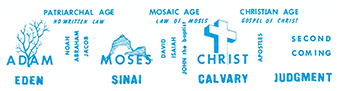
These passages also show the fallacy of those who teach that we must keep the Sabbath (or Saturday). This command was a part of the Law of Moses, the Old Covenant, and was never repeated in the New. We are no more obligated to keep this day than we are to offer animal sacrifices, another commandment found only in the Old Covenant. The first day of the week on which Christians worship (see Acts 20:7 and 1 Cor. 16:2) is not the Sabbath day. But because Jesus arose on this day it is called the Lord's day. (Rev. 1:10)
Again, the terms of salvation by which we are bound did not apply to those under the Law of Moses. Some ask, "Was not the thief on the cross saved without baptism?" While we do not know that the thief was baptized and while Jesus said to him, "Today you will be with me in paradise."(Luke 23:43) He made this promise before He died while the Old Covenant was yet in effect. "For a testament is of a force after men are dead; otherwise it is of no strength at all while the testator lives"(Heb. 9:17) the command of baptism, then, became applicable after death of Christ, while Jesus made His promise before He died.
The New Covenant is an "eternal covenant"(Heb. 13:20) by which God deals with us today. If we obey Him, He will reward us with an eternal home. How God revealed the terms of this covenant through the gospel in the establishment of His church we shall study next.