How Jesus Taught
The teaching of Jesus was characterized by simplicity. He used words the common people could understand and took His illustrations from those things with which they were familiar. Many of His principles were set forth by parables. A parable is a true-to-life story with a lesson. Thus while the story of the prodigal son (Luke 15:11-32) is a wonderful story that could have happened, Christ did not tell it just to entertain His listeners. He intended to show that a loving God will receive again His children when they stray. The number of Christ's parables is usually placed between 27 and 50, depending on what is classified as a parable. Of these a majority deal with human beings while the others are built around animals or plants or other objects with which the people were familiar.
The parable of the sower is typical of Jesus' parables. In it He tells about a man who went forth to sow. Some of his seed fell by the wayside, others on rocky ground or among the thorns, while some was planted in good ground. Only that which fell on the good ground brought forth fruit. After Jesus related this story, He then told His disciples what it meant - the seed was the word of God and the way it grew or failed to grow represented the way men received or rejected the word of God, and the fruits they brought forth in their lives.
Jesus made effective use of questions. Once He asked, "Who is my mother?" He startled the people by answering His own question by saying, "For whoever does the will of my Father in heaven is my brother and sister and mother."(Matt. 12:50) When His enemies tried to catch Him in a dilemma, He asked them a question. When they were unable to answer His interrogation, He refused to answer theirs. Sometimes He taught by example as He did when He washed His disciples' feet. He did not wash their feet because they were dirty, but to show that true greatness is measured by the service one renders to his fellow men.
What Jesus Taught
The things Jesus taught are more important than His methods. He gave man a completely new way of life which is summed up in what has been called the golden rule of the Bible, "So in everything, do to others what you would have them do to you."(Matt. 7:12) This way of life is far above that of any pagan religion and is even superior to the Law of Moses. The essence of the teachings of Jesus is in the Sermon on the Mount found in Matthew 5, 6, and 7. The student should read the entire discourse. The sermon does not have a connected thought, but is made up of sayings on different subjects. It begins with a group of "beatitudes" in which blessing is pronounced upon those who please God. For example, "Blessed are the merciful, for they will be shown mercy. Blessed are the pure in heart, for they will see God."(Matt. 5:7, 8) You will note that Jesus gives His blessing, not to the rich or famous, but to those whose hearts are right and who strive to serve God by serving their fellow men. In fact, by teaching, "Do not store up for yourselves treasures on earth... But store up for yourselves treasures in heaven,"(Matt. 6:19, 20) the Lord shows that true riches are to found in spiritual, not material things.
In the sermon Jesus shows that we may sin by thought as well as by action. "You have heard that it was said to the people long ago, 'Do not murder...' But I tell you that anyone who is angry with his brother will be subject to judgment."(Matt. 5:21, 22) Again, "anyone who looks at a woman lustfully has already committed adultery with her in his heart."(Matt. 5:28)
The words of Jesus on the subject of divorce are very clear. "But I tell you that anyone who divorces his wife, except for marital unfaithfulness, causes her to become an adulteress, and anyone who marries the divorced woman commits adultery."(Matt. 5:32) Equally plain is His declaration about oaths. "But I tell you, Do not swear at all: either by heaven, for it is God's throne; or by the earth, for it is his footstool." (Matt. 5:34, 35)
Jesus taught the principle of non-resistance in the Sermon on the Mount. Perhaps no teaching goes more counters to human nature than this. Yet if all men carried it out wars would cease tomorrow. Hear Him as He says, "You have heard that it was said, 'Eye for eye, and tooth for tooth.' But I tell you, do not resist an evil person. If someone strikes you on the right cheek, turn to him the other also."(Matt. 5:38, 39) This is hard to do, but it lies at the basis of all Christ's teachings.
The Kingdom Of God
During His personal ministry Jesus taught much about the kingdom of God. Many of His parables compared the kingdom of God to such familiar things as leaven or mustard seed. Daniel had prophesied that God would establish an indestructible kingdom. (Daniel 2:44) The Jews were looking for a temporal kingdom, but the kingdom Christ came to establish was a spiritual one. He was to reign, not on the throne of David in Jerusalem, but in the hearts of men. Jesus did not teach that He would ever establish an earthly kingdom, but He did teach that His kingdom was the church (Matt. 16:18, 19) and that it soon was to be established. In another lesson we will learn how and when it was set up.
Jesus had much to say about heaven and hell. He portrays heaven as a place to be inherited by those faithful to the Lord, but hell as the unhappy fate of those who reject God. He taught that the unprepared would be cast "into the fiery furnace, where there will be weeping and gnashing of teeth."(Matt. 13:42) But He also showed that God loved man so much that He sent His son to save him from that terrible fate.
Jesus claimed to be the Son of God. He was much more than a good moral man who taught others how to live better. He came to save the world from sin. If Jesus was not God's Son, then He was the greatest impostor in history, and His teachings cannot be trusted. But those very teachings are within themselves proof that He is the Son of God and that His claims to deity are valid.
The Invitation of Jesus
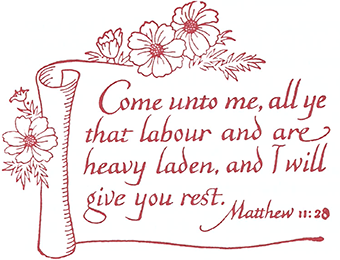
It is the wish of the Savior that men come to Him. But while He will compel no man to accept Him, He invites all. "Come to me, all you who are weary and burdened, and I will give you rest. Take my yoke upon you and learn from me, for I am gentle and humble in heart, and you will find rest for your souls. For my yoke is easy and my burden is light."(Matt. 11:28-30) Dear student, have you accepted His invitation?